Why AGP: Model Safety Is Not Operational Safety
Model guardrails govern what AI says. AGP governs what agents do across tools, systems, approvals, and audit.
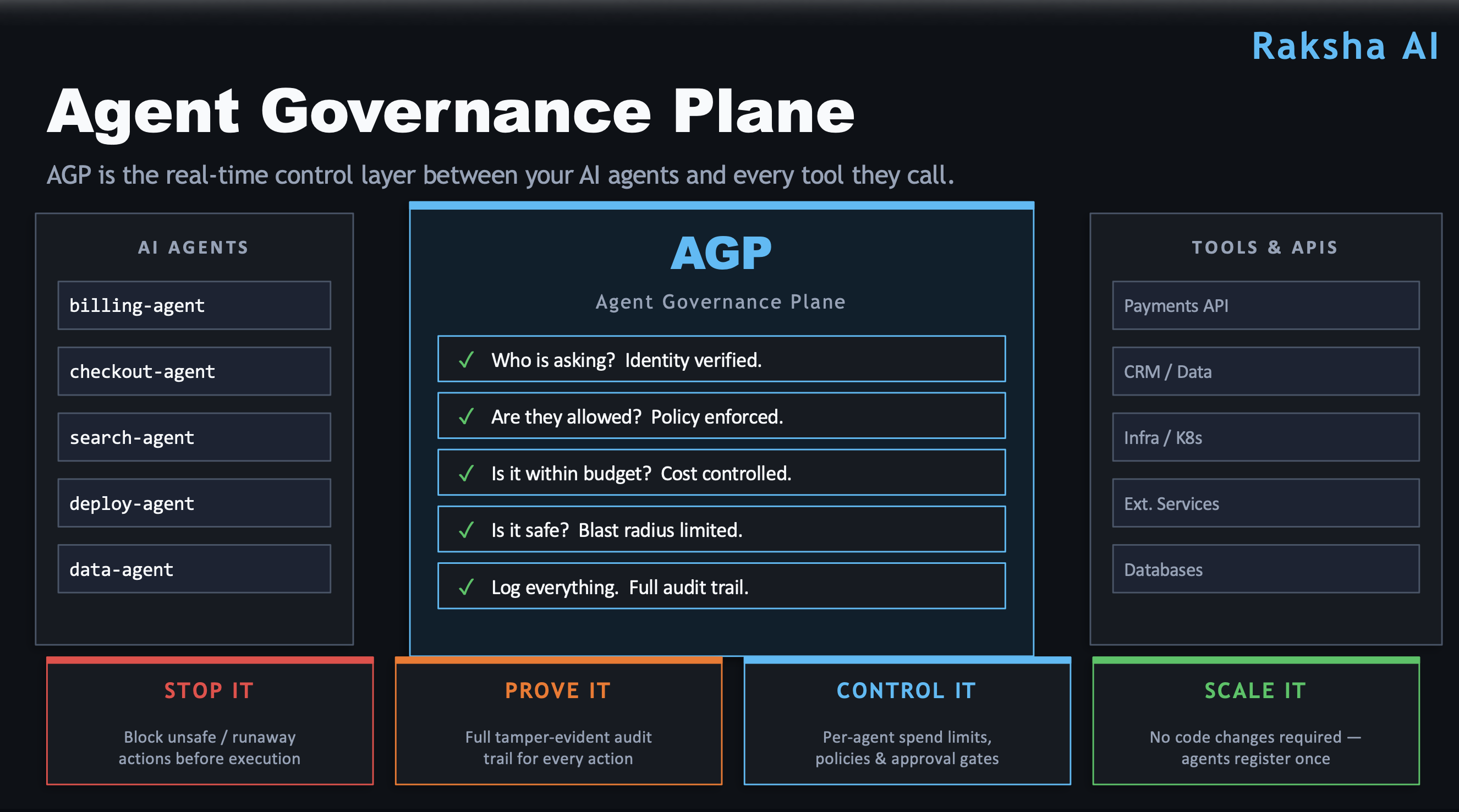
Model safety is not the same thing as operational safety.
Model safety asks whether the AI produced acceptable output. Operational safety asks whether the agent took an acceptable action.
That distinction matters because agents do not only generate text. They call tools, move data, update records, trigger workflows, and touch production systems.
The Gap
An agent can pass a model safety check and still create operational risk.
For example, the model may produce a reasonable plan while the runtime executes a dangerous tool call. The model may avoid unsafe language while a connector sends sensitive data to an unexpected destination. The model may follow instructions correctly while a compromised tool asks it to perform an action the user never intended.
In each case, the issue is not only the model response.
The issue is what happened through the agent’s tools.
Why Existing Controls Are Not Enough
LLM guardrails help shape model behavior. Logging and observability help teams understand what happened. IAM helps authenticate users and services.
But agentic workflows need a control point in the execution path.
Before a tool call completes, the runtime should be able to ask:
- Which agent is acting?
- Is the agent allowed to call this tool?
- Is this action risky in this environment?
- Is sensitive data moving somewhere unexpected?
- Does this action require human approval?
- Will the decision be auditable later?
Those questions belong at runtime, between the agent and the tool.
What AGP Adds
AGP is the Agent Governance Plane.
It sits between agents and tools to enforce identity, policy, approvals, and audit before actions execute.
That means AGP is not only watching agents. It is governing what they are allowed to do.
For enterprise AI, that is the missing safety layer: operational control over agent actions.
AGP is free to use and self-hosted — put it between your agents and your systems.